"Ako ćutiš - ćuti iz ljubavi.
Ako govoriš - govori iz ljubavi.
Ako opominješ - opominji iz ljubavi.
Ako opraštaš - oprosti iz ljubavi.
Unutrašnji koren neka bude ljubav,
Iz ovog korena može da izraste samo dobro.”
Sv. Augustin
Arhimandrite Zachariah Zacharou
Christ is the miracle that astounds us. He is the sign of God for all generations until the end of times, for in His Person every impasse has found its solution. During His earthly life, ‘He lived the tragedy of the whole mankind, and yet tragedy found no place in Him.’[1] On the contrary, before His utter humiliation, He granted peace to His disciples.
In the Person of Christ was revealed the inapproachable and eternal God, but also the true man, as God had conceived him before the foundation of the world in the bosom of the Holy Trinity in His wondrous and pre-eternal Council. In His Person all things were fulfilled, for He is ‘the way, the truth and the life’.[2]
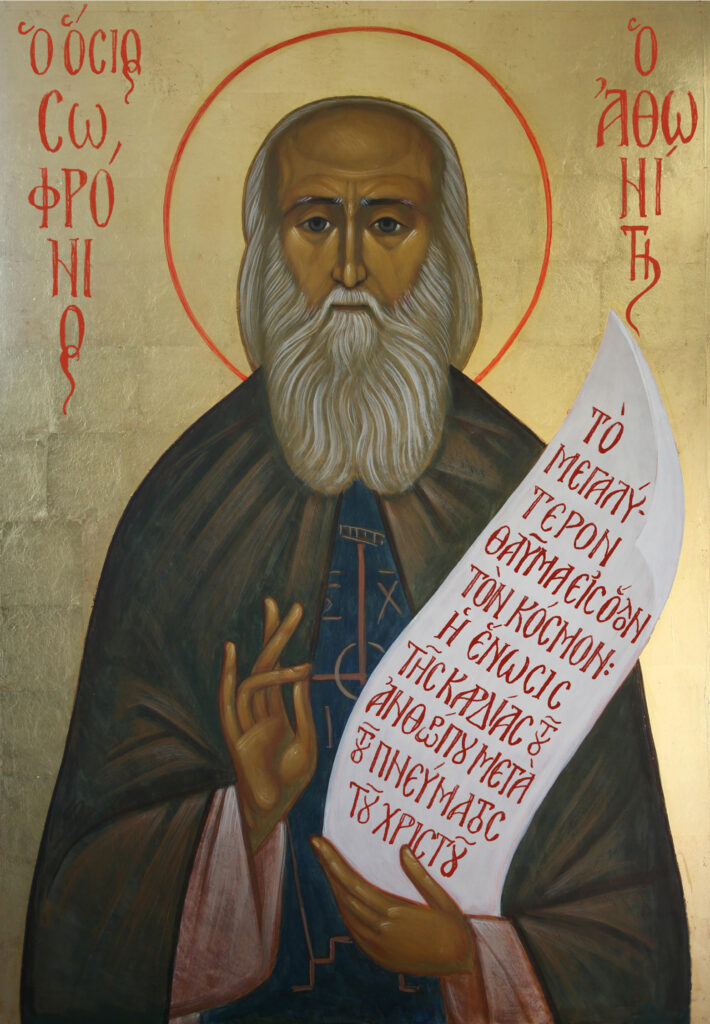
By extension, as imitations of Christ, all the Saints can also be said to be the signs of God for their generation, who give a solution ‘not of this world’ to the problems it is confronted with, be they philosophical, psychological or theological. They live in a natural way ‘the tragedy of mankind, and at the same time the peace of Christ’.[3]
‘A man shall approach and the heart is deep.’[4] It is difficult to speak about the Saints, because the man who still lives in the confines of the visible world cannot even imagine the depths of the heart of a holy Christian, the pain of his repentance and love, the infinite expanse that his prayer traverses like lightning, the freedom of his spirit.
Saint Sophrony’s earthly life lasted almost one century, but his spiritual life is unfathomable. As he himself writes about his attempt to depict the figure of his own Elder, Saint Silouan: ‘Anyone who has ever given himself over with a pure heart to contemplation of his inner self knows how impossible it is to detect the spiritual processes of the heart, because in its profundity the heart touches upon that state of being where there are no processes. But now in writing this profile I find myself faced with just such a task – portraying the evolution of a great ascetic striver.’[5]
Likewise, we cannot speak about Saint Sophrony without diminishing his greatness. Yet, by the command of the Spirit and against his own desire to live in such a way as not ‘to be seen of men’,[6] he did leave us his writings. And the best way to know the spiritual portrait of this holy man is to read his books. Every paragraph is the fruit of his prayer and the Elder is fully present in his words.
Saint Sophrony received the great blessing to rejoice in the vision of the uncreated Light when he was but an infant, yet from the first years of his youth he also felt very acutely the absurdity and vanity of temporary life. His intellectual erring on the alien paths of transcendental meditation was interrupted by the saving Sinaitic revelation that God brought before his eyes: ‘I AM THAT I AM.’[7] In his repentance he ‘would pray like one demented, weeping copious tears, afflicted to his very bones.’[8] The cry of his prayer reached back ‘to the source of the world’s tragedy’.[9]
Elder Sophrony ‘ardently loved Jesus Christ, God our Creator and Saviour’, and, ‘without fail’, according to his own words, he experienced ‘two states of being that would seem to be diametrically opposed: descent into hell (of repentance and love) and ascent into heaven’.[10]
Until the end of his life, he spoke with infinite gratitude about his Father in God Saint Silouan, whom he called ‘the most important event of his life’,[11] the greatest blessing, and he attributed every gift from on high to his prayers. He considered that the purpose of his life and his greatest task was to minister unto the word of his Elder.[12]
Saint Sophrony lived among us with great simplicity. He was warm and loving, but you could not forget for one instant the Christ-like otherness of his soul. He had a different mind, different feelings, different thoughts. Every contact with him was an opening of life. When he opened his mouth it was as if he snatched the word from God and brought it down to earth. Rather, he was incarnating the word of God in his own life. As he himself confesses: ‘His words, like fire, were imparted to my mind and heart, and I learned to see things from His perspective, because His word became my life.’[13]
Certainly, when we say that the Elder was a man of the word of God, we do not mean that he spoke about the word of God, but that he was a bearer of the quickening power of the personal God. The divine word resounded like a harp in his heart whether he was awake or asleep. In other words, he was the bearer of the word which is born in the heart through prayer and which regenerates man when it visits him, whilst when he imparts it to the others, it informs them with grace.[14] It transforms and renews them, showing unto them the ways of salvation.
We often witnessed miracles in his presence, sometimes amazing ones. However, he would never seek for them, neither would he pay much heed to them. He would pray for the ill, because he had compassion on people and desired their pain to ease, but his prayer had as its main target the heart of his neighbour. He knew that the greatest miracle in all the created world is the union of man’s heart with the Spirit of God. For this reason, he was consumed by the desire to minister this union of the temporary and earthly existence of man with the Light of the eternity of God.
He emphasised the importance of calling upon the Name of the Lord Jesus so that the impasse of human tragedy may be be overcome and that man may be born in the eternal Kingdom. He says about himself: ‘When the pain of the heart reaches the limits of physical endurance, the invocation of the Name of Jesus Christ brings the peace that keeps man alive.’[15] He ‘tormented’ with fiery prayer everything he did or said.
He also gave the greatest importance to the Divine Liturgy, whose celebration enraptured and inspired him. He said that in our times, when it is no longer possible to find favourable conditions for hesychastic life, if we celebrate the Divine Liturgy with attention, fear and the appropriate preparation, it brings the same results at the level of the spirit, the same sanctification as the prayer of the heart. For this reason he was mindful to impart to his monks and to all those who asked for his help, his love for the Divine Sacrament and the knowledge of a deeper approach to it.
Just as Moses desired to see the whole people of God prophesy, so also Saint Sophrony longed to impart to those around him the breath of the Holy Spirit, the inspiration of an artist. He even said that the Christian must be an artist in his spiritual life. As the artists are possessed by the object of their art and strive to find the perfect expression for their inspiration, so the Christian should be possessed by Christ and strive to refine his relationship with Him, running ‘that he may apprehend that for which also he is apprehended.’[16]
For some, the neighbour becomes a hindrance, for others even hell, whilst for our holy Fathers Silouan and Sophrony, the brother was their life. God enlarged their heart to embrace heaven and earth, just as Christ spread His holy hands on the Cross to embrace all people.
As a conclusion, we will quote the words of the Saint:
‘A single saint is an extraordinarily precious phenomenon for all mankind. By the mere fact of their existence – unknown, maybe, to the world but known to God – the saints draw down on the world, on all humanity, a great benediction from God… Thanks to these saints – whom the world does not know of – the course of historical, even of cosmic events, is changed. So then, every saint is a phenomenon of cosmic character, whose significance passes beyond the bounds of earthly history into the sphere of eternity. The saints are the salt of the earth, its raison d’etre. They are the fruit that preserve the earth. But when the earth ceases to produce saints, the strength that safeguards it from catastrophe will fail.’[17]
This is why Elder Sophrony considered as a sign of authentic and holy life the prayer for the whole world, wherein the man of God, enlarged by the grace of the Holy Spirit, brings to God every soul that came into being from the foundation of the world and that will be born until the end of the world.
Another criterion of genuine and holy life for Saint Sophrony, was love and prayer for enemies. This phenomenon demonstrates the presence of the Holy Spirit, without Whose grace such a virtue cannot exist in this world.
Saint Sophrony gives witness that love for enemies is the token of the presence of the Holy Spirit and of the truth of God, which justifies the ephemeral existence of man and leads him into the unfading life that reigns in the bosom of the Holy Trinity, of the Father and of the Son and of the Holy Spirit.
Archimandrite Zacharias Zacharou
8 March 2021All these Sundays before Great Lent initiate us into the wisdom of repentance and every Sunday gives us constants, principles that we must keep throughout this period for our renewal. All the lessons we receive now are meant to help us realise the greatest task of our life, that of discovering our heart and become true images of God, able to converse with Him face to Face. The Sunday of Zacchaeus has two main major themes. The first is the significance of voluntary shame in cleansing ourselves from the shame of sin that we have accumulated in this life. The second theme is the desire of God. If our ascetical labours during Great Lent are to be perfect, we need the desire of God to prevail over all things, for it is this desire that turns the whole heart to God. Saint Anthony did not measure his spiritual progress by the number of years he had spent in the desert, but by the amount of godly desire he had in his heart every time he stood before God. Godly desire overcomes every other passionate desire in this world, and then God comes to reign in our heart as King. When man turns to God like Zacchaeus, he becomes taught of God and he utters things with eternal value. It is God Who speaks through him, Who justifies him and renews his life.
Question: Was Zacchaeus in a state of grace to have this desire to see Christ?
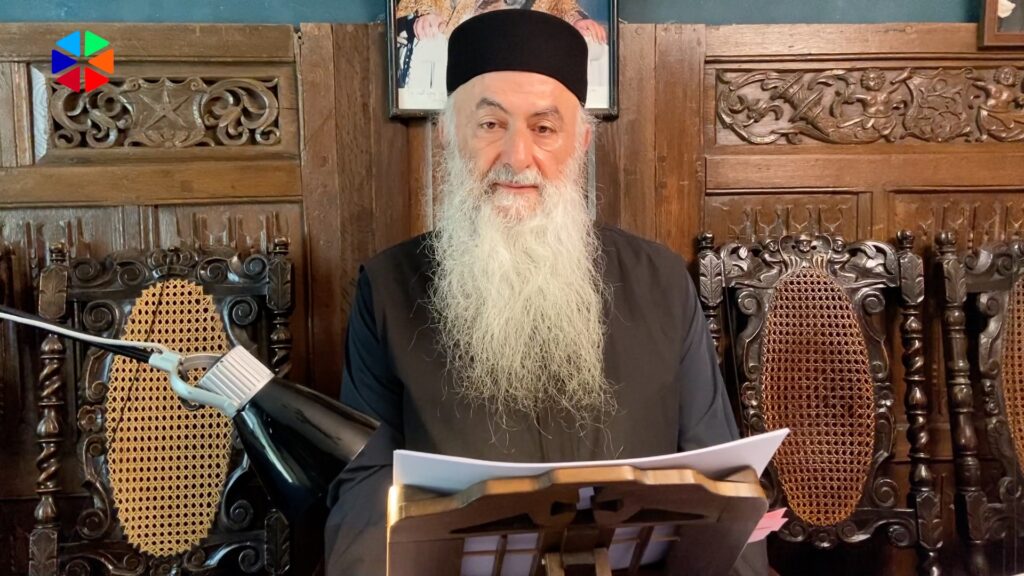
Archim. Zacharias: Grace began to work in Zacchaeus from the moment he did not consider his own honour, but gave precedence to his desire to see the Face of Christ. He ignored the good opinion of the crowd and concentrated only on seeing the Countenance of the Lord. Our soul is satiated when we are counted worthy to see His Face: ‘As for me, I will behold thy face in righteousness: I shall be satisfied, when I awake, with thy likeness’ (Ps. 17:15). Then the purpose of man’s coming into this world is fulfilled.
Question: How can a man acquire desire for God? Are we born with it?
Archim. Zacharias: We are all born with a certain innate possibility to acquire the desire of God. In order to receive grace, we must learn to humble ourselves, because God gives grace to the humble and resists the proud. Humility attracts the grace of God, which becomes inspiration and desire of God in us. Humility and the fear of God make man brave. When man has the fear of God and humility, he is afraid of nothing. Even if heaven and earth collide, he will not be shaken. He fears only one thing: not to sin against the love of his Redeemer. Zacchaeus did not say he would correct his injustices because the crowds murmured, but because of the energy of the presence of Christ. Such things cannot be decided and uttered by thinking in a psychological way. Such things come from grace boiling in the deep heart. Then man becomes like a lion in his repentance, standing before God and turning every arrow of accusation against himself with the sole desire to please Him.
Question: Can we find a balance between low self-esteem and humility?
Archim. Zacharias: This is the contrast between the psychological and spiritual level of life. As heaven is far above the earth, so is humility far above low self-esteem. Low self-esteem may be a form of self-pity or of hurt pride because of our poverty. Whereas humility is a dynamic sensation and desire that the glory of God may increase even through our decrease. These are two things which cannot be compared. We must not forget that humility is an attribute of divinity. All His manifestation on earth was an act of humility and condescension, an act of coming down to meet the lost sheep, laying aside all His glory, assuming even the shame of the Cross in order to save the world. Low-self esteem has nothing to do with the perspective of humility, which is infinite in that it is a divine virtue of Christ, which has covered the heavens (Hab. 3:3).
Question: How can we balance the calling of God with the world we live in?
Archim. Zacharias: One of the greatest temptations is to give too much significance and appreciation to the patterns and values of this world; to try and make the love of God compatible with the love of this world. It is not possible. The grace and the word of God are absolute, and when we assimilate the truth of His word and the strength of His grace, we are enabled to discern the things of this world and know that they are relative and insignificant compared to the things of God. We strive continually to acquire the light of the grace of God, and in His Light we shall see and evaluate all else: ‘In Thy light we shall see light’ (Ps. 36:9).
Question: Would Christ have refused to meet Zacchaeus if he had acted only out of curiosity?
Archim. Zacharias: If the Lord foresaw that he would be prompted by His word to change his life, He would have come to meet him. This is what He did with Nicodemus, who understood nothing of the spiritual rebirth in the Spirit, and yet the Lord received him and expounded to him the highest teaching about the new birth from on high. When we enter the world of the Spirit and embark on an adventure with God, there are no rules, no recipes: we simply follow the wind of grace.
Question: Are we not in a way always late to follow the Lord’s calling, unlike Zacchaeus?
Archim. Zacharias: For such things there is no program. We cannot say that it is too late or too early: our duty is to respond. When God calls, obey. That is all. There is no time which is late, because we know that the Lord rewards the workers of the last hour as those of the first, for He is good and gives all things to all men.
Question: How do we discern God’s calling from any other fake images of our own mind?
Archim. Zacharias: People often ask: ‘How can I know that my desire to be a monk or a nun is the will of God?’ If the will of God is active in us, it is so powerful that there is no other will. It devours the whole of man’s being. If man truly receives the inspiration and the calling to the monastic life, he can do nothing else, because he senses the absolute value of the life to which God calls him.
Question: Can we, as a married couple living in the world, dedicate all our life to Christ and live outside the camp of this world (Heb. 13:13)?
Archim. Zacharias: No one ever said that Christian life is easy: the commandments of God are not human exhortations, but the way in which He lives Himself. He gives these commandments to us so that we may become like unto Him, and this is not easy. Nevertheless, in the lives of the saints we find representatives from every category of people, including married couples who pleased God and became saints. If a couple in the world lives in peace, love and concord, and they set as a priority in their life to please God, surely God will give them the grace and humility to walk uprightly, keep all the commandments and ordinances of God, thus becoming righteous and holy.
Question: How do we overcome the sense of futility in serving people who do not want God?
Archim. Zacharias: By continually accumulating the traces of grace in our heart, seeing that the true destiny of man and his true habitation is not in this world, but in the world to come. It is only through grace that we build up our future habitation.
Question: Does God speak to us through our conscience?
Archim. Zacharias: Yes, our conscience is an unwritten law of God within us. The more we read the written word of God and the more this word dwells in us, the more powerful it becomes in guiding and inspiring our life. It is the same with our conscience: the more we cleanse it and obey it, the sharper it becomes and, as Saint Andrew of Crete says, there is nothing more violent in this world than man’s own conscience rebuking him for his sin and prompting him to correct his life for the sake of God.
Question: Is there any connection between the foolishness you spoke about and what Saint Sophrony calls ‘utter self-emptying’?
Archim. Zacharias: Yes. Saint Paul describes foolishness as not putting our confidence in our little mind and natural gifts, but in Him Who is able even to raise the dead (2 Cor. 1:9). This is true foolishness, which has value before God. Utter self-emptying, on the other hand, refers to the unique self-emptying of our Lord. Even in the hymns of the Holy Week, He is called ‘the extreme humility’, ‘the extreme self-emptying’. This is an absolute title that the Lord deserves. As for ourselves, we do not come to such a measure, but we try to follow hard after the steps of our Master.
Question: How can we confess now that churches are closed or the priest is far away?
Archim. Zacharias: If you have a long-standing relationship with your spiritual father to whom you confessed in the past years of your life, now, because of the necessity and the hardness of the times, you can do it in writing. You have not entered the Church yesterday; you have been 30-40 years in the Church now. In the letters of Saint Barsanuphius the Great, we see that he continually receives the confession of the monks from his surroundings and he gives them a word to benefit their life, to help them improve and become stronger in their spiritual struggle.
Question: Some priests do not give you Holy Communion, even if you tell them that you have the blessing of your spiritual father to partake without confessing every time.
Archim. Zacharias: I know that in some places it is required that the person should confess in that very parish in order to have Communion. In our monastery, if we are told that someone has the blessing of their spiritual father, we are one family and we honour the word of that spiritual father without asking further questions: that which a spiritual father decides should be respected in every place. In our Monastery, someone may have a thought or temptation, and he confesses it to you in the refectory or on the path. The priest cannot produce an epitrachelion and read a prayer at that moment. That is why before the Liturgy we read the prayer of absolution for all.
Question: How to remain faithful to the decision to correct ourselves for the rest of our life?
Archim. Zacharias: Saint Paul was taken up to the third heaven and yet, in order to preserve that grace, he went to meet Peter, John and James so as to have a point of reference in the Church. They recognised the gift of God in him and confirmed it. Therefore, we preserve our inspiration and desire for God, if we always join the assembly of the faithful, of the Church, where all have the same desire. Then our inspiration will not decrease.
Question: How is the total repentance of Zacchaeus, a once in a lifetime event, connected with the saying of the Fathers, ‘If you fall, get up again’, which points to a constant need for repentance?
Archim. Zacharias: In the 4th century, in the desert of Egypt, the constant prayer of all the ascetics was: ‘Lord, give me the spirit of repentance,’ because they knew that repentance is like a circle of fire that prevents man from falling into sin. There is a moment of radical confession, but this is only the beginning of salvation, not salvation itself. The Holy Fathers say that if man wants, from morning until evening he can attain to a divine measure. Yet, Father Sophrony said that this must happen every day.
Question: What advice would you give someone who wants to repent and struggles to keep the grace of God?
Archim. Zacharias: This is no simple matter. If we turn with all our heart to God, if we repent and weep before Him, He will fill us with His consolation. But how to preserve that? This is the problem we all have. Well, when we have tasted that the Lord is good, we make it a purpose to be pleasing to Him, day by day. Then we discipline ourselves and this becomes our main task in our life: to always live under the shadow of His grace. That is why Saint Paul says ‘I discipline myself, I keep under my body, and bring it into subjection: lest that by any means, when I have preached to others, I myself should be a castaway’ (1 Cor. 9:27). Thus, we learn to preserve grace more and more. Do not be astonished if you lose it a thousand times. We keep losing grace, but one thing remains: we never stop seeking for it and humbling ourselves until God is well-pleased to return to us. In a kneeling prayer of Pentecost, we say: ‘To Thee we sin, O Lord, but it is Thee that we adore.’ Our adoration must become stronger and stronger so that it may swallow up all our sins.
Question: Can you say a word about the feast of the Meeting of our Lord?
Archim. Zacharias: Righteous Symeon had the same desire to see the Lord’s Christ (Luke 2:26), and this desire kept him alive for many years. When he receives the Lord in his arms he sung his triumphal song, ‘Lord, now lettest thou thy servant depart in peace… for mine eyes have seen thy salvation’ (Luke 2:29-30). THE DESIRE OF GOD KEEPS THE SOUL ALIVE. Even his desire to depart from this life and be with God was in the perspective of Saint Paul’s words: ‘having a desire to depart, and to be with Christ; which is far better’ (Phil. 1:23). Such is the desire of the perfect
‘We went through the fire and water; but Thou broughtest us out into a place of refreshment.’[1]
Pentecost completes the cycle of the great feasts of the Dispensation of the Lord. The Holy Spirit came to seal the salvation of mankind wrought by the Lord Jesus. On this day, the Sunday of All Saints, the Church teaches us that the Saints are the fruit of the Holy Spirit. On the day of Pentecost, the Heavenly Father shed the gifts of the Holy Spirit like rain. Wherever these gifts found good earth, they bore the fruit of holy life. Thus, Pentecost is not just the birthday of the Church, but also of all her Saints. The Saints are the fruit of the Spirit of holiness, the foremost light-bearing children of the Church, whose work it is to produce images and likenesses of Christ. For the Church of the Old Testament this work was impossible. It adhered to the letter of the law, unable to conceive within its bowels the Spirit which ‘bloweth where it listeth’.[2] Thus it failed to bring forth the fruit of holiness and was discountenanced by the Lord.[3]
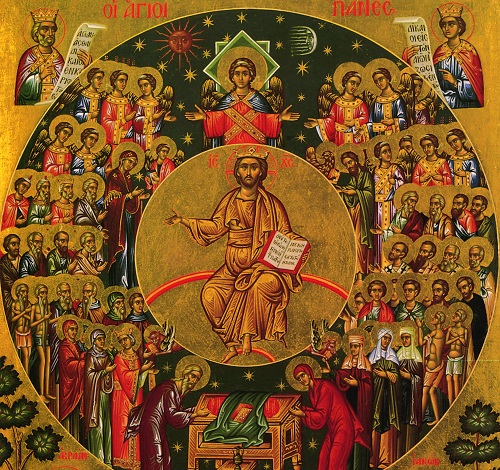
‘The judgement of God must begin at the house of God.’[4] ‘The house of God’ is Christ above all. The ‘judgement of God’ means the judgement that annuls death and reveals divine love ‘unto the end’. This judgement is made manifest in the unjust death of the Lord Jesus for the sake of the world’s salvation.
Each man who follows the Lord Jesus[5] is the ‘House of God’ and thus the judgement of God has to be repeated in his life. Holy Scripture bears witness that this judgement acts throughout history and perpetuates the grace of salvation for every generation because our God, is the God of our Fathers. The Lord has formed Fathers and children, and the children in their turn become Fathers. Christ is ‘the Father of the age to come’,[6] He is the Author of a new humanity, regenerated through the grace of the Holy Spirit, without any preceding sin. Through His death and Resurrection, Christ gave the grace of rebirth to those who participate in His paternity. ‘But as many as received Him, to them gave He power to become the sons of God, even to them that believe on His name: Which were born, not of blood, nor of the will of the flesh, nor of the will of man, but of God.’[7]
God does not command a natural life, but a life beyond nature. Desiring to give His chosen equal honour with Christ, he subjects them to the chastening unto which He also delivered His Only-begotten and beloved Son. The Lord often leads His chosen to the threshold of death, so as to slay every desire within them, not only their passions, but even the desire for life in this world. Only then is the miracle of spiritual rebirth made possible.[8]
As we can discern in the lives of the Saints, the chastening of the Lord is oftentimes harrowing. ‘It is a fearful thing to fall into the hands of the Living God’.[9] God allows afflictions, sufferings and trials to come upon His faithful servants, so that the souls of the Saints, already in this life, may abide in the depths of hell. However, within this immense darkness, they encounter the Lord Jesus, Who, in His descent to hell and His ascent above the heavens has ‘filled all things with Himself’.[10] Thus, His faithful servants can unite with Him no matter what the conditions, a fact which abolishes all impasses and gives a new perspective to suffering and tragedy. ‘Yea, though I walk through the valley of the shadow of death, I will fear no evil: for thou art with me; thy rod and thy staff they comfort me.’[11]
The grace of meeting the Lord leaves ineffaceable marks upon us. Henceforth, the soul lives in the assurance that nothing can separate her from the love of Christ, neither ‘tribulation, or distress, or persecution… nor death nor life …nor any other creature.’[12] Returning to everyday life, man is dead to every attraction and temptation of the world, because he has known something indescribably greater, indescribably more glorious.
When the Saints passed through periods of trial and chastening so as to enter into the glorious place of God’s presence, they learnt many mysteries of the spiritual life. Perhaps the greatest mystery is that which Saint Silouan referred to as the ‘Great Science’. This science teaches man how to humble his spirit, so as to remain out of reach of the enemy’s attacks and free his heart to love God.
The Saints, the images of Christ, follow the ‘Lamb slain from the foundation of the world’,[13] Who hastens to suffer for man’s salvation. The perspective of the Gospel inverts every aspect of the established order: ‘That which is highly esteemed among men is abomination in the sight of God.’[14] Whosoever embraces the inverted perspective of the Gospel, inevitably crucifies his mind and reason. This crucifixion attracts grace, which works self-hatred in the soul for the ‘abomination of desolation’ hidden within her bosom. This energy, vehement by nature, cuts man from everything created and joins him to the Person of Christ, so that he attains to perfect likeness unto Him.
Following the footsteps of Christ, the Saints of all ages, the Apostles, the martyrs, and the ascetics tasted a voluntary death according to the commandments of God, so as to overcome in their corruptible flesh the involuntary death to which mankind is condemned due to preceding sin. Through perfect obedience and surrendering to the holy will of God, they put to death every trace of self-love. They continually experienced the passage from death to life, and lived only for their Redeemer and Saviour Jesus.
The life of the Saints was crowned with martyrdom either external or internal, that is, ‘in secret’. The ascetics poured out tears striving unto blood to cleanse their heart from the passions, to render it comely and give all its space to God to ‘walk and dwell therein’.[15] Throughout their lives they were as those appointed to death, battling against the spirit of pride, because experience taught them the inviolable truth of the revelation of the Lord, that ‘He resists the proud, but gives grace to the humble’.[16] They knew that when they humbled their spirit and set themselves below every creature, they received grace, which works the great miracle of the passage from darkness to light and preserves the unbreakable union of man’s heart with the Spirit of God.
Salvation is nothing other than man’s entrance into the communion of the Saints. Certainly, very few from each generation inherit the grace of the Saints, but when man receives their word with trust and follows it faithfully, even if he has not comprehended its depth, he receives a portion of grace, which becomes the key to entering into their sublime assembly. In this way the poor and humble are enriched by the glorious and entirely sanctified members of this communion. Participation in the Mysteries of the Church, and above all in the Divine Liturgy, opens the gate of Paradise, where the faithful enjoy divine bliss in communion with God, the Angels and the Saints and treasure up the grace of salvation.
‘Many are your names and greater are your gifts.’ Despite the general degeneration of the latter days, the Church has not yet lost its ability to produce images of Christ. This is a perceptible grace that cannot be found in any other confession. Even if these ‘images of Christ’ may not work miracles in a manifest way, they work the greatest miracle day by day in their lives, according to Saint Silouan: ‘They love the sinner in his fall.’[17] Wrought by the grace of the Church, this fact alone disperses every doubt and disbelief which would impede man from surrendering with trust to all the teachings of Christ and His Saints. ‘God is wonderful in His Saints.’[18]
The Saints in this world are ‘a sweet spiritual fragrance’. They are the brightest stars in the noetic firmament of the Church who attest to ‘Jesus Christ the same yesterday, and to day, and for ever’[19] and ‘with us alway, even unto the end of the world’.[20] They give a pattern and an example. Through their voluntary death they prove themselves conquerors of involuntary death. Just as the Jews before their exodus from slavery to the Egyptians ate the Passover ‘in haste’, thus also the saved walk upon the earth and live in this world hastening towards the unshakeable and eternal. Their converse is with heaven; they steadfastly direct the eyes of their soul there, whence they will receive their Saviour and Redeemer. Sometimes they cast a glance to the earth, only to discern the misery and poverty of this transient life, and then they turn with greater longing to the plenitude of Heaven, the only thing that can fill the chasms within the heart. This was already the culture of the Saints during the first Christian centuries, when they all shared the recognition that they were strangers and sojourners in this world. As they had lived the passage ‘from the bondage of corruption into the glorious liberty of the children of God’,[21] they knew God not only as Judge and avenger, but as a Father ‘the closest and dearest of fathers’.[22]
‘The soul that has come to know God through the Holy Spirit strains up to Him; the memory of God powerfully raptures her mind, and the world is forgotten. And when the soul remembers the world, her ardent desire is for all men to receive the same grace, and she prays for the whole world. The Holy Spirit Himself moves her to pray that all men may repent and know God, how merciful He is.’[23]
‘We went through the fire and water; but Thou broughtest us out into a place of refreshment.’[1]
Pentecost completes the cycle of the great feasts of the Dispensation of the Lord. The Holy Spirit came to seal the salvation of mankind wrought by the Lord Jesus. On this day, the Sunday of All Saints, the Church teaches us that the Saints are the fruit of the Holy Spirit. On the day of Pentecost, the Heavenly Father shed the gifts of the Holy Spirit like rain. Wherever these gifts found good earth, they bore the fruit of holy life. Thus, Pentecost is not just the birthday of the Church, but also of all her Saints. The Saints are the fruit of the Spirit of holiness, the foremost light-bearing children of the Church, whose work it is to produce images and likenesses of Christ. For the Church of the Old Testament this work was impossible. It adhered to the letter of the law, unable to conceive within its bowels the Spirit which ‘bloweth where it listeth’.[2] Thus it failed to bring forth the fruit of holiness and was discountenanced by the Lord.[3]
‘The judgement of God must begin at the house of God.’[4] ‘The house of God’ is Christ above all. The ‘judgement of God’ means the judgement that annuls death and reveals divine love ‘unto the end’. This judgement is made manifest in the unjust death of the Lord Jesus for the sake of the world’s salvation.
Each man who follows the Lord Jesus[5] is the ‘House of God’ and thus the judgement of God has to be repeated in his life. Holy Scripture bears witness that this judgement acts throughout history and perpetuates the grace of salvation for every generation because our God, is the God of our Fathers. The Lord has formed Fathers and children, and the children in their turn become Fathers. Christ is ‘the Father of the age to come’,[6] He is the Author of a new humanity, regenerated through the grace of the Holy Spirit, without any preceding sin. Through His death and Resurrection, Christ gave the grace of rebirth to those who participate in His paternity. ‘But as many as received Him, to them gave He power to become the sons of God, even to them that believe on His name: Which were born, not of blood, nor of the will of the flesh, nor of the will of man, but of God.’[7]
God does not command a natural life, but a life beyond nature. Desiring to give His chosen equal honour with Christ, he subjects them to the chastening unto which He also delivered His Only-begotten and beloved Son. The Lord often leads His chosen to the threshold of death, so as to slay every desire within them, not only their passions, but even the desire for life in this world. Only then is the miracle of spiritual rebirth made possible.[8]
As we can discern in the lives of the Saints, the chastening of the Lord is oftentimes harrowing. ‘It is a fearful thing to fall into the hands of the Living God’.[9] God allows afflictions, sufferings and trials to come upon His faithful servants, so that the souls of the Saints, already in this life, may abide in the depths of hell. However, within this immense darkness, they encounter the Lord Jesus, Who, in His descent to hell and His ascent above the heavens has ‘filled all things with Himself’.[10] Thus, His faithful servants can unite with Him no matter what the conditions, a fact which abolishes all impasses and gives a new perspective to suffering and tragedy. ‘Yea, though I walk through the valley of the shadow of death, I will fear no evil: for thou art with me; thy rod and thy staff they comfort me.’[11]
The grace of meeting the Lord leaves ineffaceable marks upon us. Henceforth, the soul lives in the assurance that nothing can separate her from the love of Christ, neither ‘tribulation, or distress, or persecution… nor death nor life …nor any other creature.’[12] Returning to everyday life, man is dead to every attraction and temptation of the world, because he has known something indescribably greater, indescribably more glorious.
When the Saints passed through periods of trial and chastening so as to enter into the glorious place of God’s presence, they learnt many mysteries of the spiritual life. Perhaps the greatest mystery is that which Saint Silouan referred to as the ‘Great Science’. This science teaches man how to humble his spirit, so as to remain out of reach of the enemy’s attacks and free his heart to love God.
The Saints, the images of Christ, follow the ‘Lamb slain from the foundation of the world’,[13] Who hastens to suffer for man’s salvation. The perspective of the Gospel inverts every aspect of the established order: ‘That which is highly esteemed among men is abomination in the sight of God.’[14] Whosoever embraces the inverted perspective of the Gospel, inevitably crucifies his mind and reason. This crucifixion attracts grace, which works self-hatred in the soul for the ‘abomination of desolation’ hidden within her bosom. This energy, vehement by nature, cuts man from everything created and joins him to the Person of Christ, so that he attains to perfect likeness unto Him.
Following the footsteps of Christ, the Saints of all ages, the Apostles, the martyrs, and the ascetics tasted a voluntary death according to the commandments of God, so as to overcome in their corruptible flesh the involuntary death to which mankind is condemned due to preceding sin. Through perfect obedience and surrendering to the holy will of God, they put to death every trace of self-love. They continually experienced the passage from death to life, and lived only for their Redeemer and Saviour Jesus.
The life of the Saints was crowned with martyrdom either external or internal, that is, ‘in secret’. The ascetics poured out tears striving unto blood to cleanse their heart from the passions, to render it comely and give all its space to God to ‘walk and dwell therein’.[15] Throughout their lives they were as those appointed to death, battling against the spirit of pride, because experience taught them the inviolable truth of the revelation of the Lord, that ‘He resists the proud, but gives grace to the humble’.[16] They knew that when they humbled their spirit and set themselves below every creature, they received grace, which works the great miracle of the passage from darkness to light and preserves the unbreakable union of man’s heart with the Spirit of God.
Salvation is nothing other than man’s entrance into the communion of the Saints. Certainly, very few from each generation inherit the grace of the Saints, but when man receives their word with trust and follows it faithfully, even if he has not comprehended its depth, he receives a portion of grace, which becomes the key to entering into their sublime assembly. In this way the poor and humble are enriched by the glorious and entirely sanctified members of this communion. Participation in the Mysteries of the Church, and above all in the Divine Liturgy, opens the gate of Paradise, where the faithful enjoy divine bliss in communion with God, the Angels and the Saints and treasure up the grace of salvation.
‘Many are your names and greater are your gifts.’ Despite the general degeneration of the latter days, the Church has not yet lost its ability to produce images of Christ. This is a perceptible grace that cannot be found in any other confession. Even if these ‘images of Christ’ may not work miracles in a manifest way, they work the greatest miracle day by day in their lives, according to Saint Silouan: ‘They love the sinner in his fall.’[17] Wrought by the grace of the Church, this fact alone disperses every doubt and disbelief which would impede man from surrendering with trust to all the teachings of Christ and His Saints. ‘God is wonderful in His Saints.’[18]
The Saints in this world are ‘a sweet spiritual fragrance’. They are the brightest stars in the noetic firmament of the Church who attest to ‘Jesus Christ the same yesterday, and to day, and for ever’[19] and ‘with us alway, even unto the end of the world’.[20] They give a pattern and an example. Through their voluntary death they prove themselves conquerors of involuntary death. Just as the Jews before their exodus from slavery to the Egyptians ate the Passover ‘in haste’, thus also the saved walk upon the earth and live in this world hastening towards the unshakeable and eternal. Their converse is with heaven; they steadfastly direct the eyes of their soul there, whence they will receive their Saviour and Redeemer. Sometimes they cast a glance to the earth, only to discern the misery and poverty of this transient life, and then they turn with greater longing to the plenitude of Heaven, the only thing that can fill the chasms within the heart. This was already the culture of the Saints during the first Christian centuries, when they all shared the recognition that they were strangers and sojourners in this world. As they had lived the passage ‘from the bondage of corruption into the glorious liberty of the children of God’,[21] they knew God not only as Judge and avenger, but as a Father ‘the closest and dearest of fathers’.[22]
‘The soul that has come to know God through the Holy Spirit strains up to Him; the memory of God powerfully raptures her mind, and the world is forgotten. And when the soul remembers the world, her ardent desire is for all men to receive the same grace, and she prays for the whole world. The Holy Spirit Himself moves her to pray that all men may repent and know God, how merciful He is.’[23]
Today, one week after Pentecost, again we celebrate a feast, commemorating all the Saints that were well pleasing to the Lord in this life and partook of His imperishable life. Last Sunday we celebrated the coming of the Comforter and the immaculate Church, in her wisdom, has instituted this feast to commemorate all the Saints, the renowned fruit of the Holy Spirit. The Saints of every age provide palpable evidence of the truth of God and the wondrous Tabernacle built on earth with the coming of the Holy Spirit. They bear witness to the integrity of the Church who bears in her bosom these earth-bound Angels, these Heavenly men.
The secret Person, the Holy Spirit, the hidden friend, is revealed outright in His gifts to the Saints. The image of Christ is painted in the heart of the faithful by the Spirit of Truth, the Person of the Holy Spirit, and is marked upon the Saints of the Church in each age. The Holy Spirit gives an eschatological orientation to man’s life because He quickens, now in the present moment, Christ’s awaited coming, His burning presence, that will consume and destroy the lawless,[1] while stirring up a furnace of desire in the hearts of ‘those who loved His appearing’,[2] enabling them to ‘lay aside all earthly care’.
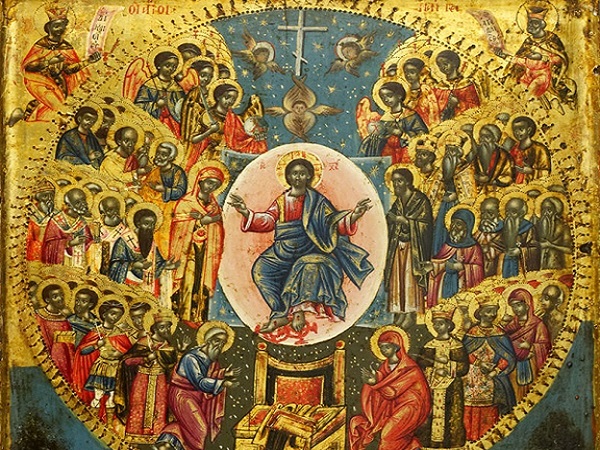
The hypostatic principle, as set forth by Saint Sophrony, is realised by all the Saints in their very being. The mystery of Pentecost is active in their lives at all times, as they attract the grace of the Holy Spirit and spread it out over the world, on behalf of which they untiringly intercede. ‘They were chosen of the Holy Spirit to pray for the whole world, and the Holy Spirit gave them a well-spring of tears.’[3] ‘The Lord bestowed the Holy Spirit upon the Saints and in the Holy Spirit they love us… The Holy Spirit gives His chosen such a wealth of love that their souls burn as it were with a flame, in their desire that all men should be saved and behold the glory of the Lord.’[4]
There are three levels of life: the unnatural, the natural and the Divine. The unnatural is the demonic life of eternal oblivion and hatred for God and man.[5] The natural is expressed in man’s love for ‘those who love him‘,[6] which is not censurable, but it is not enough for salvation. The supernatural life led by the Saints aims to recompense the Lord the tender love that we owe Him according to His commandment. The precepts of the Lord do not refer to the given fact of natural life, but to a supernatural life. They were imparted to man to detach him from the transient and shakeable, lifting him onto the transcendent level of divine love. The Holy Spirit heals ‘every wound hidden within us’, it cures the pestilence of forgetfulness of God, renews the soul and leads first to what is natural and then to what is beyond nature, as is attested by the Saints of all generations.
The man who tastes the gift of the Holy Spirit, irrevocably directs himself towards what is higher, because every separation from his Creator, albeit brief, creates an acute pain in his heart and he experiences an awesome darkness, all the terrors of hell, the corruption of death. In the eyes of the world this state appears to be madness. However, according to the Apostle Paul, it is ‘wiser than the wisdom of men’,[7] because God saved man through the madness and weakness of His love. As Saint Silouan writes: ‘The soul from love of the Lord has lost her wits as it were. She sits in silence, with no wish to speak, and looks upon the world with crazed eyes, having no desire for it and seeing it not.’[8]
Today’s Gospel reading,[9] a synthesis of verses from two different chapters of Saint Matthew’s Gospel, speaks about two elements that characterise the lives of the Saints: good confession and taking up the cross. In His incomprehensible condescension and goodness, the Lord granted the works of his hands parity with Himself, concluding a covenant with man on equal terms. If any man confesses Him, Christ will confess him as his own before the Heavenly Father. If any man forgives the small and relative sins of his fellow men, then God will forgive the great sins and evils that have affronted Him since before all ages.[10] Man’s confession belongs to the level of the temporary, the kingdom of transience. The confession of God takes place where ‘time is no longer’[11] and leads mortal earth-bound men into eternity.
Confession ‘in Christ‘is an inner confession of life in the Spirit. It is an imitation of the ethos of the Lamb of God ‘brought as a sheep to the slaughter’.[12] It is a life of holiness within the world of sin and passions. The true witness does not make portentous proclamations, but bears the living sensation of God in his heart. He speaks, walks, breathes as like unto the Son of God.
The Lord also witnesses in the Spirit to salvation within the heart of man, through the incorruptible consolation flooding him, through the ‘unique gift’ that makes him acceptable before the Heavenly Father and a member of the communion of the ‘spirits of the Saints made perfect’. This witness is possible when there is living communion with the Lord, a ‘bond of love’[13] and faith forged with Christ and all the members of His Body, because only together with all the Saints can anyone comprehend ‘what is the breadth, and length, and depth, and height; and know the love of Christ that passeth all knowledge’.[14]
Whoever is engrafted within the Body of Christ seals a covenant with the Lord. Already in this life, he tastes the first fruits of a dynamic relationship with Him that is always changing from fulness to fulness and will be perfected in eternity. The spirit that inspires this relationship differs fundamentally from the spirit of this world and inevitably splits the believer away from its values, so he makes ‘foes from his own household’.[15]
The Holy Spirit enlarges the heart to lead man ‘into all truth’, into all the fulness of divine love that enfolds ‘Heaven and earth and the nethermost parts of the earth’[16] with its Light. The epode of the Akathist for the Saints ends with the verse: ‘Rejoice thou, universal Fathers’. Some of these Saints never left the holes in the earth where they laboured in asceticism within the desert, but the content of their heart was all Adam, ‘from one end of the earth to the other, from the beginning of Creation till the end of times’ and they presented the whole world before the throne of God in their prayer of intercession.
As Saint Sophrony bears witness: ‘Wherever man may betake himself, whatever desert he may retire to, if he treads the path of real life in God he will live the tragedy of the world, and live it even more intensely and profoundly than those actually in the world, because the latter do not know what they are missing. Men suffer many privations but with the rare exception they are not conscious of their main lack. When they are deprived of their worldly goods and realise what they are missing, they suffer and lament; but what would the weeping and wailing be like if they realised their chief deprivation! With what ardour would they seek ‘the one thing needful’.[17]
According to the Apostle Paul, some people sow corruption through sinful actions, but others sow eternity through good works.[18] The fiery prayers of the Saints for their personal salvation and the salvation of the world are preserved by the angels until the Second Coming as precious incense in golden vials.[19] The Day of the Lord will be a surprise, not only because no one will know ‘the times or the seasons’,[20] but because all ‘the secret things of man’s heart’[21] will be made manifest. The genuine and faithful servants of God do not reveal the power of the Spirit and the love that they bear within them. Often the taking up of the cross is the hidden work of a man who battles again sin in the depths of his being, who seeks the Light of humility and strives not to trample upon the covenant that he has concluded with the Lord. He takes up the cross because he yearns not to be confined any longer within the suffocating frame of his own self, but to live for the Lord, Who bought him with His precious blood.
God promises divine equality, desiring to say to man, ‘all that I have is thine’,[22] but first he puts his true children to the test to see if they will respond with gratitude and philotimo to His promises and not answer, ’Have me excused, I cannot come.’[23] The judgement of the Lord’s unjust death is repeated in each of His Saints. He allows suffering and temptations in their life that try their heart like gold in a furnace.[24] ‘As gold in the furnace hath he tried them, and received them as a burnt offering.’[25] He permits that they may descend even into hell, not that they might perish, but so they might have the honour of knowing the path of the Lord Jesus unto the end. In this way, they may share in the victory of His Cross and Resurrection, becoming brethren of the ‘Firstborn’[26] and Beloved Son of love.
